
Article Summary
For B2B CEOs in the $1M–$50M range, this article argues that your revenue problem is usually a system problem, not a headcount problem—and that’s why the choice between a fractional CRO and a full-time CRO matters so much.
Below ~$20M, a fractional CRO often beats a full-time CRO because you don’t yet have the complexity to fully utilize a 40–60 hour/week executive, but you *do* have enough pain to benefit from senior revenue design, GTM focus, and better forecasting on a part-time basis.
The article walks through where each model wins (cost, speed to clarity, risk, and best stage), shows what a great fractional CRO actually does in the first 90 days—diagnosis, positioning, process, metrics, and hiring
—and ends with a simple decision rule: rent a fractional CRO when you need to design or fix the revenue engine, hire a full-time CRO when you already have a working engine that’s ready to scale.
If you’re a B2B CEO in the $1M–$50M range, you already know you have a revenue leadership problem—you just don’t know whether the answer is a VP Sales, a full-time CRO, or a fractional CRO. This guide is designed to help you make that decision with clear eyes, not to sell you on any one model.
The Real Question: What Problem Are You Solving?
Most CEOs in this range are wrestling with some mix of:
Stalled or choppy growth despite “doing more marketing and sales.”
Too much dependence on founder/CEO-led selling.
A pipeline that looks decent on paper but refuses to close.
Sales, marketing, and CS all “busy,” yet not rowing in the same direction.
Those aren’t headcount problems. They are system problems: GTM design, positioning, process, forecasting, and hiring for the right roles at the right time.
The right question isn’t “Should I hire a CRO or a fractional CRO?”
It’s: “Do I need someone to design and fix the revenue system, or someone to run an already-designed system at scale?”
Side‑by‑Side: Full-Time CRO vs Fractional CRO
Here’s the simple comparison most CEOs wish they’d seen a year earlier.
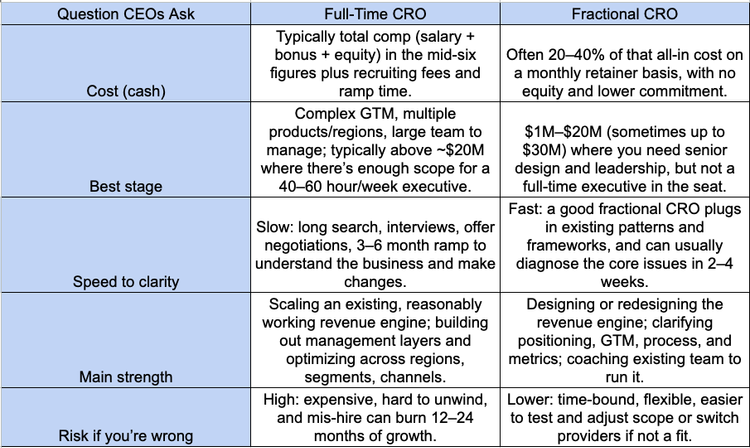
This is why for many $1M–$20M B2B companies, a fractional CRO is not a consolation prize. It’s the capital-efficient way to get senior talent earlier than your org chart technically “deserves.”
When a Fractional CRO Clearly Beats a Full-Time CRO
There are specific situations where the fractional model is almost always the better move for a scaling CEO.
1. You’re Between $1M and ~$20M, and Growth Has Stalled
At this stage, your issues are rarely about “not enough effort.” They are about:
Fuzzy ICP and positioning—your website and pitch sound like everyone else’s.
A sales process that lives in people’s heads, not in a shared system.
No consistent way to forecast or understand why deals are actually won or lost.
These are design and architecture problems, which suit a fractional CRO who can drop in, run a series of structured diagnostics, and re-architect your revenue engine while the team keeps selling.
A full-time CRO at this stage often ends up acting like an expensive VP Sales—managing deals and people—because there isn’t enough true strategic complexity to justify their full capacity.
2. You Can’t Justify or Don’t Want a $350K–$500K+ Executive Yet
By the time you add salary, bonus, equity, benefits, and recruiter fees, a full-time CRO can easily cost $350K–$500K+ per year.
Fractional CRO retainers often fall in the $8K–$25K per month range depending on scope and stage, which is roughly 20–40% of the full-time cost while still giving you C-level thinking and scar tissue.
If what you really need is 10–20 hours per week of high-quality strategy and leadership—not another 40 hours of management—fractional is structurally a better fit.
3. You Need a Diagnostic, Not Just “More Activity”
If your win rates are inconsistent, your CAC is creeping up, and you keep missing the forecast for reasons no one can clearly explain, you don’t have an execution problem—you have a diagnostic problem.
This is precisely the kind of problem fractional CROs are built to solve: focused, high-leverage work to find bottlenecks across sales, marketing, and CS, then design the system that removes them.
Once the system is in place, you can decide whether a full-time CRO or a strong VP Sales is the right long-term operator.
When a Full-Time CRO Is the Right Answer
There are also clear cases where you should skip fractional and go straight to a full-time CRO.
You likely need a full-time CRO if:
You’re above ~$30M–$50M with multiple products, geos, and segments, and a large commercial org to manage.
You already have a reasonably working GTM model and now need someone to scale it, build layers of management, and run complex cross-functional initiatives.
You’re entering an aggressive M&A or international expansion phase where you truly need 40–60 hours a week of one person’s focused attention on revenue.
In those situations, fractional can play a bridge role—helping clarify the model, documenting it, and even helping you hire and onboard the right full-time CRO—but they shouldn’t be a permanent substitute.
What a Great Fractional CRO Actually Does in the First 90 Days
CEOs often ask, “If I bring in a fractional CRO, what will they actually do with us?”
While every engagement is different, a strong first 90 days typically includes:
Diagnosis and Clarity
Deep dive into pipeline, win/loss, pricing, segments, and current GTM motions.
Interviews with sales, marketing, CS, and, importantly, customers.
Identification of the 3–5 biggest constraints blocking growth.
GTM Focus and Positioning
Tightening the ICP and value proposition so the team stops chasing everything that moves.
Aligning messaging across website, decks, and outbound to reflect real customer outcomes, not internal jargon.
Process and Pipeline Design
Defining a practical, stage-based sales process that matches how your buyers actually buy.
Cleaning up CRM stages, qualification criteria, and pipeline hygiene so you can finally trust your forecast.
Forecasting and Metrics
Agreeing on a small set of leading and lagging indicators that actually tell you what’s happening (not 47 vanity KPIs).
Building a simple operating cadence: weekly pipeline reviews, monthly revenue reviews, quarterly strategy resets.
Hiring and Org Design
Clarifying which roles you actually need next: AE vs SDR vs RevOps vs marketing, in what sequence.
Helping you upgrade existing talent, coach high-potential people, and replace chronic underperformers when necessary.
In other words: they design and install the revenue engine, then either continue to optimize it with you, or help you transition to a full-time leader once the complexity and budget justify it.
A Simple Way to Decide: Rent or Hire?
If you’re still on the fence, use this quick mental model:
Choose a fractional CRO if:
You’re between ~$1M and $20M and your main issues are clarity, focus, and system design.
You need senior help but can’t or don’t want to commit $350K–$500K+ to a single revenue leader yet.
You want to learn what kind of full-time CRO you actually need before you hire one.
Choose a full-time CRO if:
You’re closer to $30M–$50M+ with genuine complexity and a large commercial team.
You already have a working model and need someone to scale and manage it, not redesign it from scratch.
You’re comfortable making a multi-year, high-cost bet on one executive.
If you’re a CEO in that $1M–$50M band and want a neutral view of which path fits your stage, I recommend scheduling a single working session with a seasoned revenue operator (fractional or not) whose only brief is: “Help me decide whether I should rent or hire.”
That one decision, made clearly, often saves 12–18 months of drift and more cash than most growth experiments you’ll run this year.
FAQs
Here are FAQ options that will reinforce your positioning, pre-handle objections, and drive conversions without sounding salesy:
FAQs
How do I know if my problem is a “system problem” vs a “people problem”?
If you’re seeing inconsistent win rates, unclear forecasting, or constant “we just need more pipeline” conversations, it’s almost always a system issue. People problems usually show up after you have a clear system and someone consistently fails within it.
Will a fractional CRO actually move the needle if they’re only part-time?
Yes—because the highest-leverage revenue work isn’t about hours, it’s about decisions. A strong fractional CRO focuses on architecture (ICP, positioning, process, metrics), which unlocks your existing team’s output rather than trying to outwork them.
What’s the biggest mistake CEOs make when hiring a CRO too early?
They hire a full-time CRO hoping for strategy but end up paying for management. Without a defined system, even a great CRO defaults into deal support, firefighting, and acting like a VP Sales.
How long should I expect to work with a fractional CRO?
Most engagements run 6–18 months. The goal isn’t dependency—it’s to design, stabilize, and then either transition to an internal leader or keep fractional support for ongoing optimization.
Can a fractional CRO help me hire my future full-time CRO or VP Sales?
Absolutely. In fact, this is one of the highest ROI use cases. They can define the role correctly, run the hiring process, and de-risk the decision so you don’t make a $500K mistake.
What results should I expect in the first 90 days?
You should expect clarity before growth: a tighter ICP, cleaner pipeline, a defined sales process, and a forecast you can actually trust. Revenue acceleration typically follows once those foundations are in place.
Is a fractional CRO just a consultant with a fancier title?
No. A good fractional CRO doesn’t just advise—they own outcomes. That includes driving decisions, implementing changes with your team, and being accountable to revenue metrics, not just recommendations.
When does a fractional CRO stop being the right fit?
When your business has enough scale and complexity (multiple segments, teams, geos) that it requires a full-time operator to manage and expand an already-functioning system.
What if I already have a VP Sales—does a fractional CRO still make sense?
Often, yes. A fractional CRO can sit above or alongside a VP Sales to design the system and coach them into a stronger operator, rather than forcing them to invent the system themselves.
How do I evaluate a good fractional CRO vs a weak one?
Look for structured thinking and pattern recognition: how they diagnose problems, how quickly they get to root causes, and whether they tie everything back to ICP, process, and metrics. If it feels like generic advice, it probably is.
About The Author
Sanjit Singh is a Fractional Chief Revenue Officer and Founder & CEO of Boltt.io, where he helps B2B CEOs with $1M–$50M in revenue break through stalled growth and build scalable, repeatable revenue engines. He has led multiple startups and mid-market companies from zero to tens of millions in ARR, including growing an AI-driven marketing startup to a $24M run rate before a successful Series B exit. His work focuses on sharpening ICP and positioning, fixing leaky funnels, and turning random sales activity into a data-driven, metrics-backed go-to-market system.
Today, Sanjit “rents out” senior revenue leadership so CEOs can de-risk big bets, learn what great looks like, and move faster without hiring a full-time CRO too early. He is known for rolling up his sleeves with sales teams, translating board-level strategy into simple execution plans, and coaching founders to become confident, numbers-first revenue leaders. Sanjit is a frequent podcast guest, speaker, and advisor on fractional CRO models and B2B revenue strategy, and he shares practical playbooks for building high-performance go-to-market teams at Boltt.io and on LinkedIn.